The agency design partner program, 10 seats
Built for agencies that actually partner with their clients.
ROI Insights is 100% independent, built for the client's benefit, and exactly what good agencies want because of it. If you ride out the ups and downs, adjust strategy with the client, and sit through the hard conversations, this is the measurement layer you've been missing.
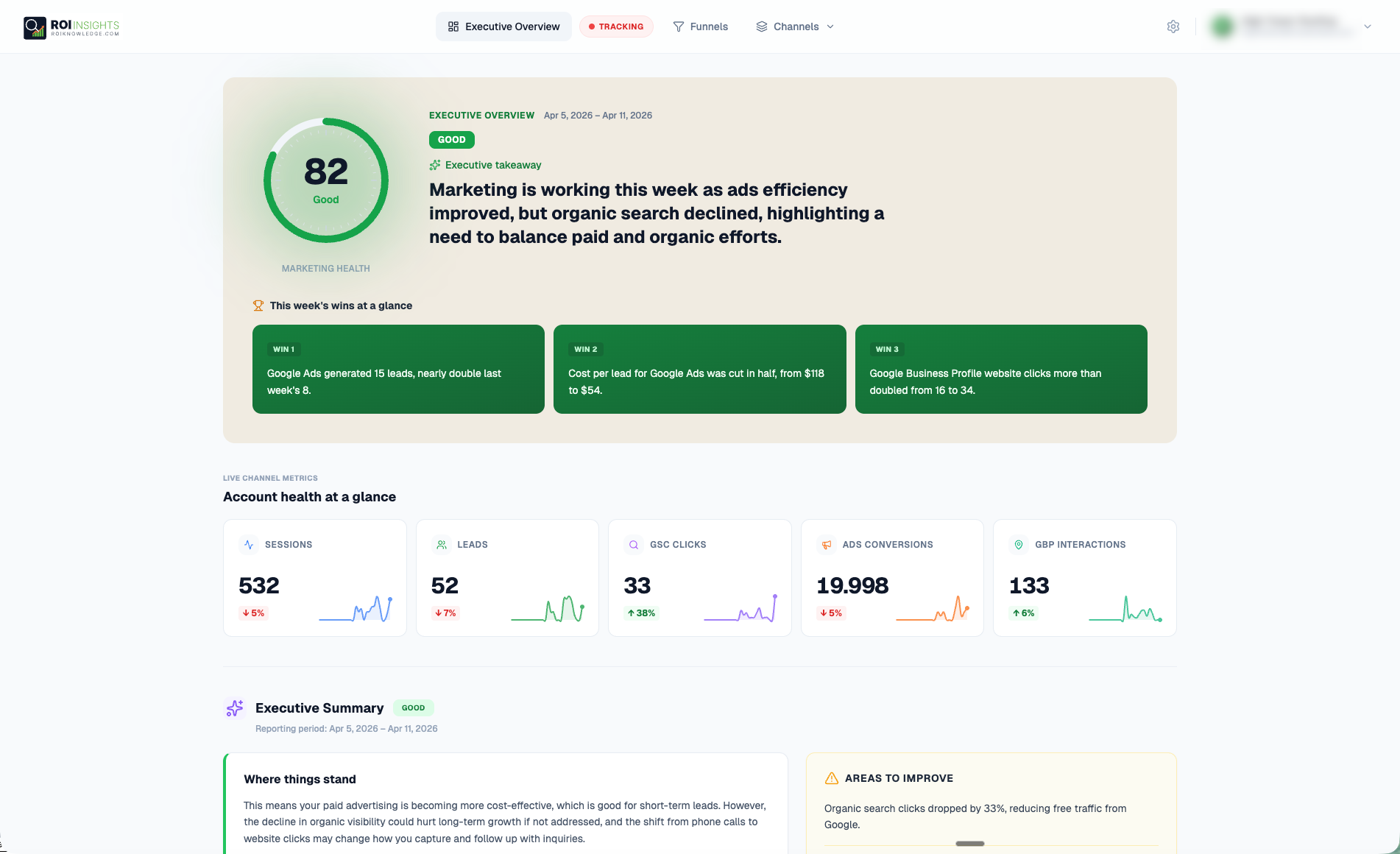
Agency Rollup
All clients healthy
The quiet part out loud
You've been blamed for outcomes you didn't cause. You've had no way to prove it.
Every agency owner has lived some version of the same story. Client signs up. You run the campaigns. Leads come in. Six months later the client stops returning calls, fires you, and tells their network you "didn't produce results." You know the truth: their website was broken for two weeks, they missed seventeen phone calls last month, they ignored the three action items you sent for four months straight. You just had no way to prove it.
The client who spent $6,000 a month on Google Ads, closed twelve jobs from your campaigns, and then fired you because "sales are down," without mentioning that their sales rep quit in March. The difficult client who refused to install call tracking because "we don't need that" and then accused you of inflating conversion numbers. The chargeback. The bad review from someone whose account you over-delivered on. The referral that dried up for reasons you'll never fully understand.
This isn't a marketing problem. It's a structural problem. When the agency producing the work is also the party reporting on the work, the relationship has no independent ground to stand on. The client is reading your report. They don't trust it even when it's right. And every disputed number lands in your lap to defend.
Good agencies with difficult clients need this most of all. It's how you prove what you did while the client blamed you for what they didn't. The fix isn't better reports. Better reports still come from you. The fix is an independent measurement layer sitting upstream of everyone's reporting: yours, the client's, the Looker Studio dashboard you built them, the Whatagraph snapshot you send on the 3rd. Same data source. Same numbers. Nobody is grading their own work.
When you and the data both say the same thing, the argument stops.
The flip
The agencies who install this get three things their competitors don't.
The product is independent. It serves the client. Good agencies use that fact as a competitive advantage, because honest measurement quietly proves what they've been saying all along. It changes three conversations you have with clients and prospects. The shift is bigger than most agency owners expect.
The renewal conversation
Every quarterly review stops being a PowerPoint of agency-produced charts. The client has their own dashboard. Alerts route to them in real time when something meaningful happens. When you sit down for the review, the client isn't seeing your interpretation of the quarter; they're seeing an independent read they already had access to. If you're producing leads at $82 while their direct mail is producing them at $340, the renewal is short. If you're not, you deserved to lose the account. Now you know which clients you're actually winning with.
The prospect conversation
Walking into a pitch with "here's what we produced for client X last quarter, independently measured" is a different conversation than "here's a case study we wrote about ourselves." Prospects can tell the difference. The close rate on pitches you walk in with proof reflects it.
The firing conversation you avoid
Most client terminations happen in the fog between "I don't feel like this is working" and "let me look at what it's actually doing." Independent measurement forecloses the fog. The client who is about to fire you either has data supporting that call (in which case you should have been fired) or doesn't (in which case they calm down when they see the numbers). Either outcome is better than being fired on vibes.
The deliverable question
We're not here to build a better report. We're here to replace the need for most of them.
Every agency owner we talk to is paying somewhere between $200 and $800 a month for a reporting tool: AgencyAnalytics, Whatagraph, ReportGarden, DashThis, Swydo, or a stitched-together Looker Studio setup that consumes more hours than any of them. Every one of those tools has the same problem. They take whatever data exists in the client's Google accounts and arrange it into a PDF your client may or may not read. If the data is wrong, incomplete, or missing attribution, the PDF inherits the problem. You ship it anyway because the client needs something on the first of the month.
That's what a report is. Backward-looking. Neutral. A document. Silent.
What ROI Insights produces is a different thing entirely. Every week, the Weekly Advisor Briefing lands in your inbox, and your client's inbox too if you've configured it that way. It reads every data source you've connected (GA4, Google Ads, Search Console, Google Business Profile, call tracking, offline channels with UTM tracking), correlates across all of them, and tells you what changed, why it probably changed, what's at risk, and what to do about it this week. It has a point of view. It has recommendations tagged by role. It reads like a short email from a strategic advisor who actually looked at the data, not like a PDF dump of charts. It's short enough to get read. It's forward-looking enough to be worth reading.
We're being direct about this: traditional reporting is our lowest priority on purpose. Every piece of marketing we publish is about how the reports agencies send clients don't tell anyone the truth, so we're not about to turn around and pretend reports are our core value. They're a byproduct of doing the upstream work correctly. The Weekly Advisor Briefing is the deliverable we actually care about. And because the measurement layer is independent (not your work, not your interpretation, just what the data says), the briefing carries weight with clients that an agency-produced report never could. Most design-partner agencies are telling us they expect to cancel their existing reporting tool within the first quarter. We'll know soon.
A report is a document. An advisor briefing is a voice with a point of view. Not the same thing.
The program
The agency program is in active development. We're onboarding 10 design-partner agencies at $499/month.
A quick note on where this came from. ROI Insights wasn't originally built to sell. It started inside our own marketing agency years ago, the internal dashboard we used to manage our own client accounts because nothing on the market actually measured marketing the way we needed to measure it. Around the time we started layering AI into it, our business was shifting into custom development and we were getting ready to shelve the tool. Enough of you kept asking for something like this that shelving it started to feel like the wrong call. This is what happens when we listen.
Every feature in the Business tier works today. The agency-specific features (roll-up dashboard, account manager multi-client view, white-label reporting) are being built with input from the design-partner cohort. If you want a seat at the table while this is being built, and a $499/month rate locked in, that's what the program is.
Shipping today
- Measurement layer installed at each client (plugin, npm package, or script tag)
- Up to 25 active client sites per agency account
- Full Business-tier features per client: Weekly Advisor Briefing, call recording and transcription, full attribution, two years of retention, wholesale telecom rates
- MCP AI agent access: hook Claude or ChatGPT directly into your agency's client data
- Bring your own call tracking (WhatConverts, CallRail, GoHighLevel) or use ours at wholesale rates
- Per-client data isolation: nothing aggregates across your client book, ever
In development
- Client roll-up dashboard: all 25 clients on one screen, health scores at a glance
- Configurable alerts: ad spend spikes, disapprovals, campaign anomalies, and performance drops route to you, your account managers, or directly to the client via email, Slack, or SMS
- Account manager views: assign team members to specific clients with scoped access
- Agency-level monitoring: know the moment any client's campaigns break, without checking 25 dashboards
- Bulk actions: apply tracking configurations across multiple clients at once
- API access and Looker Studio connector: for agencies that want to build their own downstream views
- Done-for-you dashboard customization: paid add-on if an agency wants us to build a specific client-facing view
Pricing
$499 per month. Up to 25 active client sites. Locked for design partners.
No per-client overage fees up to 35 sites (the 25-site number is the comfortable ceiling, not a hard cap). Everything in Business tier is included for every client. The $499 rate is locked for the first 10 agencies in the design-partner cohort, for as long as the subscription stays active. After the cohort fills, the rate and structure change for new agencies.
- Up to 25 active client sites (soft cap at 35, talk to us beyond that)
- All Business-tier features per client, across every site
- Design-partner access to agency roadmap features as they ship
- Direct line to the product team for feature input
- MCP AI agent access
- Bring-your-own call tracking supported (WhatConverts, CallRail, GoHighLevel) or use ours at wholesale rates
- No management fees. No percentage of client ad spend. No upsells.
The math, since we're being direct about it
Business tier is $199/month per site. 25 sites at retail would run $4,975/month. The design-partner rate is $499/month. You're paying roughly 10% of retail to be a founding agency on this program. We're telling you this plainly because we want agencies who see the math clearly.
The clarity call isn't a sales pitch. It's an intake. We listen to how you run your agency, what your client mix looks like, and what measurement problem you're trying to solve. If we're not the right fit, we'll tell you on the call.
Not ready for the program yet?
The Free tier works for agencies too, with no site limit. Install the measurement layer across every client site you manage at zero cost. You get core tracking, basic call logging, UTM attribution, and 60 days of history per site. No Weekly Advisor Briefing, no advanced attribution, no 2-year retention. When you're ready for the design-partner program, the door's open.
Honesty check
This isn't for every agency. Read this before you book the call.
We'd rather you self-select out now than onboard, hit month two, and realize the fit was wrong. Here are the situations where the program doesn't land.
You run a SEO-only agency with no paid media and no offline channels.
ROI Insights is a measurement layer for multi-channel marketing. If every client you have is pure organic search, you'll use maybe 20% of the product. A lightweight SEO reporting tool is cheaper and does what you need.
You operate as a vendor, not a partner, and that's how you want to keep it.
Independent measurement creates the kind of transparency growth-partner agencies want and vendor agencies avoid. If your billing model and client relationship are built on the agency controlling what gets reported and how, adding an independent layer on top will introduce friction you don't want. We'd rather tell you that plainly than sell you a subscription that makes both of us unhappy.
You depend on a white-label fulfillment partner and can't directly act on what the data shows.
This one isn't about quality. Some excellent agencies run on white-label fulfillment. But the measurement layer surfaces issues in close to real time: a disapproved ad, a broken landing page link, a campaign that's suddenly underperforming. If you don't control the execution directly and have to pass issues down the chain to a white-label partner, the alerts land somewhere they can't do much. ROI Insights works best when you can see a problem and fix it. If there's a handoff in the middle, the value drops.
You're looking for a reporting tool that makes your work look good with minimal scrutiny.
That's not what this is. Traditional reporting tools exist for that reason and some of them are excellent. Use one.
You don't have the time or operational capacity to onboard at least five clients in your first thirty days.
The design-partner rate is contingent on you actually using the product with real clients and giving us feedback. If your team is too slammed to install and configure the measurement layer across at least five client sites in the first month, this isn't the right moment. Come back when it is.
If none of those apply: you run a multi-channel agency, your work is solid, you can act directly on what the data shows, and you want independent measurement to prove it. Keep reading.
FAQ
Questions agencies ask
The client's. That's the honest answer, and it's the whole point. ROI Insights is an independent measurement layer: it reads data from your clients' accounts, runs its own AI analysis on what the data actually means, and serves the client's interest ultimately. The AI interprets the data; what it doesn't do is put your agency's thumb on the scale. Here's the subtle thing though: that's why good agencies want it. If your work produces real outcomes, independent measurement is the thing that finally proves it, without you having to be the one making the claim. Agencies who are doing the job well use independent measurement as a competitive advantage. It's the ones who are optimizing their reports to hide something who find this uncomfortable, and we're comfortable with that sort.
Yes. That's the point. We're not asking you to add ROI Insights on top of your existing reporting stack. We're building a product honest enough that most agencies realize within the first month or two that they don't need their old reporting tool anymore. If you want to keep it running as a backup for the first month of overlap, go ahead. Most of our design-partner agencies don't renew it after that. We'd rather be honest about this than pretend there's room for both tools in your budget.
The measurement layer installs into each client's Google accounts via standard OAuth, the same sign-in process every client has used on a dozen other sites. The client can execute the OAuth themselves, or the agency user can connect it on their behalf from the agency dashboard. Either path works. One thing worth noting: a client account can never "see into" the account that connected it. The only actions a client can take on the connection are to disconnect and reconnect. They cannot browse the agency's other connected accounts or see other clients' data. That isolation is deliberate, and it's important for agencies managing many clients in one dashboard.
That's your call. The measurement layer installs inside the client's accounts, which they technically own, so full transparency is the cleanest path. Some agencies present it as "we're adding an independent measurement layer that ensures the numbers we report are third-party-verified." Others point clients directly to their ROI Insights dashboard and let the Weekly Advisor Briefing speak for itself.
The data stays in the client's Google accounts, where it always was. When you remove a client site from your agency subscription, that site defaults back to the Free tier of ROI Insights automatically. The measurement layer keeps running, just without the Business-tier features. If the client has tracking phone numbers they want to keep active, they'll need to set up billing directly, either by subscribing to a paid plan themselves or purchasing platform credits to keep the phone lines running. Either way, they don't lose history.
Full white-label isn't likely to happen, and we want to be honest about why. Our entire marketing position is that traditional reports are broken and agencies should stop optimizing for them. Putting serious engineering into a white-labeled reporting experience would contradict that position. What IS on the roadmap for design partners: API access (pull ROI Insights data into whatever you build), a Looker Studio connector (for agencies who want to produce custom downstream views), and done-for-you dashboard customization as a paid add-on. We'd rather build those things honestly than pretend to be a white-label reporting platform.
Talk to us on the clarity call. The soft cap is 35 before we need to have a conversation. Above 35 clients, pricing becomes case-by-case; there aren't enough multi-hundred-client agencies in the design cohort yet for us to have a clean rate card, and we'd rather build one with real agencies than guess.
The Free tier works for agencies too, with no site limit. You can install the measurement layer across every client site you manage at zero cost and still get core tracking, basic call logging, UTM attribution, and 60 days of history per site. It's not the full product. No Weekly Advisor Briefing, no advanced attribution, no client-facing dashboards, no configurable alerts, no 2-year retention. But it's the measurement layer, and it's running. When you're ready for the design-partner program, the door's open.
Ten seats. Book a 30-minute clarity call.
The cohort is capped at 10 agencies for a reason: we want to actually hear what each one needs and build against real feedback, not try to accommodate 100 agencies at once. We originally built this inside our own agency. We know what it's like to want independent measurement on your side. The clarity call is thirty minutes. We learn what you run, what your client mix looks like, and what measurement problem you're trying to solve. You learn whether this is worth getting in on early.
If the cohort is full by the time you book, we'll tell you on the call and put you on the waitlist at the original $499 rate. The design-partner seats go in order of the calls, not the page views.
Prefer to write first? [email protected]